Tag: homesteadingforbeginners

  • Homesteading Is Like an Umbrella

    Homesteading Is Like an Umbrella

    There’s this idea floating around online that homesteading has to look a certain way. Perfect gardens. Acres of perfect green pasture. Perfect chicken coops with matching feed bins and cute little signs hanging over the nesting boxes. Social media has a way of making it feel like every homestead should look like it belongs in a magazine or on Pinterest, and honestly, if that’s what someone wants to build, that’s completely fine. There’s nothing wrong with wanting beautiful raised beds, coordinated décor, or chickens gracefully wandering around a perfectly maintained yard. Some people genuinely enjoy creating that kind of space, and if that’s their dream, they should absolutely go for it.

    But the truth is, homesteading is not — and never will be — one size fits all.

    I’ve started explaining homesteading like an umbrella. At the center of that umbrella is the idea of living a little closer to the land, your food, your family, and yourself. Then branching out from that center are all the spokes. Gardening can be one spoke. Raising chickens can be another. Baking bread, canning food, composting, preserving harvests, learning herbal remedies, sewing, cooking from scratch, hunting, fishing, budgeting, DIY projects, raising livestock, collecting rainwater, or even just growing herbs in a windowsill planter can all be spokes on that umbrella.

    And the best part? You get to choose which spokes belong on your umbrella.

    That’s what makes homesteading so customizable. You don’t have to do every single thing. You don’t have to know how to milk a cow, butcher a chicken, sew your own clothes, bake sourdough, and grow a year’s worth of food just to call yourself a homesteader. Maybe you love gardening but chickens completely freak you out because tiny dinosaurs with attitude are not your thing. Cool — then don’t get chickens. Maybe you love cooking from scratch but have zero interest in sewing your own sweaters or hemming pants. Honestly, same here. If I tried sewing anything important, there’s a good chance I’d somehow make it worse instead of fixing it. Maybe your version of homesteading is learning how to preserve food. Maybe it’s raising rabbits. Maybe it’s growing tomatoes in containers on an apartment patio. Maybe it’s learning to rely a little less on convenience culture and a little more on yourself.

    It all counts.

    Somewhere along the way, I think people started believing that if your homestead doesn’t look polished enough, organized enough, or productive enough, then you’re somehow “doing it wrong.” I absolutely hate the phrase “real homesteader” because who exactly gets to decide that? I’ve had old-timers tell me, “That’s not homesteading. Homesteading means working the land.” And historically, sure, that’s where the term came from. But language evolves. Lifestyles evolve. People evolve. Today, homesteading means a lot of different things to a lot of different people.

    To me, if someone is trying to live more intentionally, learn useful skills, become more self-sufficient, connect more deeply with their food, or simply slow down and appreciate the process of creating instead of constantly consuming, then they belong in this community too.

    And honestly? Most homesteads in real life do not look like the polished pictures online.

    Most homesteads have junk piles somewhere. Scrap metal leaning against fences because “we might need that someday.” Random buckets with mysterious purposes. Half-finished projects. Feed bags stuffed in corners. Broken gates fixed with baling twine and determination. Coops held together with screws, zip ties, leftover wood, and hope. There’s usually at least one project that’s been “almost finished” for six months. That’s real life. That’s normal.

    And there’s something kind of beautiful about that too.

    Because most homesteaders aren’t wealthy people building a curated lifestyle for social media. Most are regular people simply trying their best to create a better life for themselves and their families with what they have available. They’re learning as they go. They’re making mistakes. They’re figuring things out one season at a time.

    That’s another thing people don’t talk about enough: homesteading can be hard. There’s a learning curve to everything. Plants die. Animals get sick. Fences fail. Gardens get destroyed by weather, pests, or pure bad luck. You’ll spend hours working on something only to realize you did it wrong and have to start over. There will absolutely be moments where you wonder why you’re doing any of it at all.

    And yes, there will probably be moments where you want to quit.

    I know I’ve had those moments.

    I’ve sat there wondering what life would look like if I didn’t have animals depending on me, chores waiting for me, weeds taking over the garden, projects piling up, or one more thing needing repaired. Sometimes it feels overwhelming. Sometimes it feels exhausting.

    But then I think about who I was before all of this.

    Before the animals. Before the garden. Before learning these skills.

    Back then, something always felt missing. I couldn’t explain it at the time, but I felt disconnected from everything. Now, even after the longest days, there’s this feeling of fulfillment that’s hard to describe unless you’ve experienced it yourself. There’s purpose in it. There’s meaning in growing something with your own hands, caring for animals, building something useful, learning new skills, and creating a life that feels more grounded and intentional.

    Homesteading isn’t about perfection.

    It’s about connection.

    Connection to your food. Connection to your environment. Connection to your family. Connection to your own capabilities. It’s about realizing you can learn things you never thought you could learn. It’s about understanding that self-sufficiency isn’t an all-or-nothing lifestyle. Every small step counts.

    And the beautiful thing is, you can start almost anywhere.

    You do not need acres of land. You do not need a giant farmhouse. You do not need expensive equipment. You do not need to know everything before you begin. I don’t care if you live in an apartment, a rental, a tiny house, or yes, even your mother’s basement — although maybe help your mom with the dishes if you do. My point is, you can still start learning. You can still grow herbs in a window. You can still learn to cook from scratch. You can still compost. You can still preserve food. You can still build skills that make you more confident, capable, and connected to the world around you.

    You start where you are.

    You use what you have.

    You grow what you can.

    And maybe that’s really what homesteading is all about.
  • The Time, Effort, and Gratitude Behind Home-Raised Meat on the Homestead

    The Time, Effort, and Gratitude Behind Home-Raised Meat on the Homestead

    The Time and Heart That Goes Into Raising and Preserving Your Own Meat

    Homesteading isn’t just about collecting eggs and growing tomatoes — it’s about the long hours, the learning curves, and the deep appreciation that comes from providing for your own family. This fall, I was reminded of just how much time (and love) goes into raising and preserving our own animals — especially when it came time to process our turkeys.

    Meet Kirk, the Turkey Who Thinks He’s a Chicken

    Our original plan was to breed our own turkeys this year. We wanted to raise a few from our flock to fill the freezer for winter, but our tom, Kirk, had other ideas.

    Kirk was a late bloomer and was given to me before we had any other “keeper” turkeys. He grew up with the chickens, and somewhere along the way, he decided he was one. Unfortunately, that led to some trouble — he even killed one of my hens trying to breed her. He never quite figured out his role, and despite his best efforts, our Spanish Black hens remained unimpressed. Poor Kirk… a big chicken at heart.

    Bringing in the Big Birds

    Since breeding didn’t go as planned, we decided to order Broad Breasted White turkeys from McMurray Hatchery again. They grow fast and put on weight quickly — great for the freezer, but not so great if you wait too long to butcher. These birds can get huge, and once they reach a certain size, they’re hard to handle.

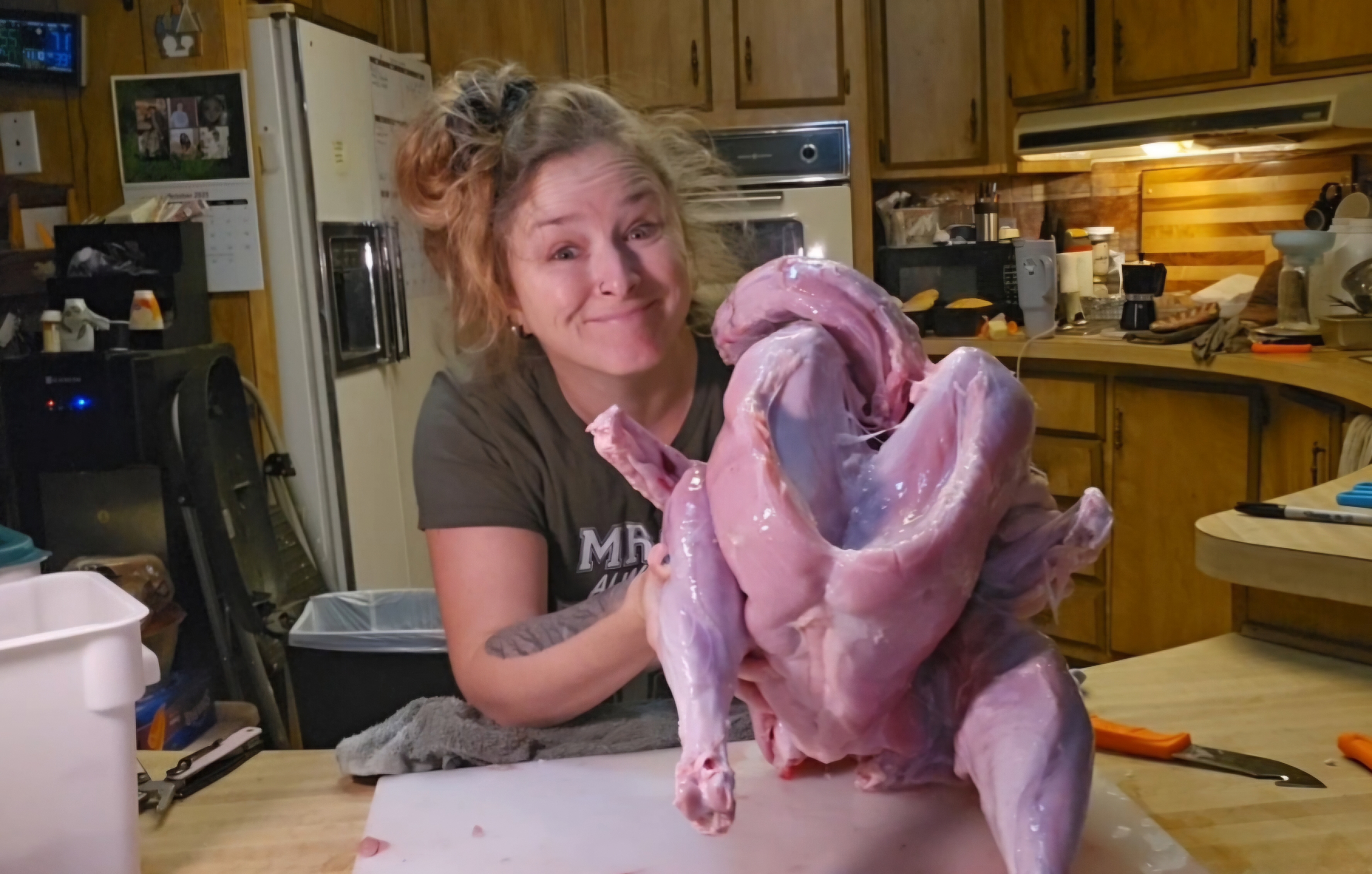
    It’s definitely a two-person job. My husband and I tackled the butchering together — I held, he chopped — quick and humane. I decided to skin them this time instead of plucking. For one, they don’t fit in my plucker. And two, even if they did, I physically couldn’t lift those heavy birds in and out of the scalding pot all day.

    And because timing is never perfect on a homestead, the weekend we processed six turkeys turned out to be a busy one — and rainy, of course. But it got done. Because that’s homesteading. Rain, mud, feathers, and all.

    From Rainy Day to Freezer Full

    After processing, we let the birds rest in coolers for 48 hours so rigor mortis could pass. Out of the six we butchered, I parted out five and kept one whole as a gift for a friend — the same friend who gave me a pair of mated Royal Palm turkeys this summer. I told her I had her Thanksgiving covered.

    If you’d like to see how I part out a turkey step-by-step, I filmed the process for YouTube — you can watch it here (it’s short, simple, and shows what works best for me).

    Preserving the Harvest

    I’ll be canning some of the turkey, turning some into homemade deli meat, and freezing the rest in meal-sized bags. That way, I can pull one out anytime for soups, crockpot meals, or a quick dinner. It took several days of hard work, but every time I open the freezer or see a row of jars cooling on the counter, I’m reminded it’s always worth it.

    Knowing exactly where our food comes from — how it was raised, butchered, and preserved — means so much to us. It’s strange to think I haven’t bought meat from a grocery store in who knows how long. It’s not always easy, but it’s real, rewarding work.

    And at the end of the day, I’m simply grateful — for the effort, for the lessons, and for the opportunity to live this life.

    Preserving the Harvest

    I’ll be canning some of the turkey, turning some into homemade deli meat, and freezing the rest in meal-sized bags. That way, I can pull one out anytime for soups, crockpot meals, or a quick dinner. It took several days of hard work, but every time I open the freezer or see a row of jars cooling on the counter, I’m reminded it’s always worth it.

    Knowing exactly where our food comes from — how it was raised, butchered, and preserved — means so much to us. It’s strange to think I haven’t bought meat from a grocery store in who knows how long. It’s not always easy, but it’s real, rewarding work.

    And at the end of the day, I’m simply grateful — for the effort, for the lessons, and for the opportunity to live this life.

    🦃 Watch the Video

    Want to see how I part out a turkey? Watch the video here:

  • “I Can’t Do It All” to “I’ll Do It My Way”: Finding Freedom in Everyday Homesteading

    Homesteading has a way of making us feel like we have to do everything all at once. You scroll through Pinterest or Instagram and see the perfect bread loaves, the spotless garden rows, the DIY farmhouse kitchen, and you think—“I can’t do it all.” And honestly? You’re right.

    But here’s the secret: you don’t have to.

    Homesteading isn’t about perfection or doing everything in one season. It’s about creating a lifestyle that works for you, in your space, on your budget, with your schedule. When you shift your mindset from “I can’t do it all” to “I’ll do it my way,” homesteading suddenly becomes doable, sustainable, and—most importantly—enjoyable.

    Perfection Isn’t the Goal—Progress Is

    There’s a lot of pressure in the homesteading world to make everything picture-perfect. But let’s be real: your goats are going to break a fence, your garden will get weedy, and that sourdough starter might flop. That doesn’t mean you’re failing—it means you’re learning.

    Progress happens in the small steps: planting one raised bed this year instead of an entire acre, raising two chickens before you invest in a full flock, or canning just a few jars instead of a pantry wall. These little wins build your skills and your confidence.

    Pinterest-Worthy vs. Real Life

    Pinterest and Instagram can be inspiring, but they can also be discouraging. Behind every “perfect” homestead photo is a mess you don’t see—the dishes piled up in the sink, the weeds just out of the camera frame, the failed projects tucked away in the shed.

    Real life homesteading is messy. It’s mud on the boots, crooked fences, and bread that doesn’t always rise. And that’s okay. What matters isn’t how it looks online—it’s how it feels to you.

    Doable and Workable Beats Perfect

    A homestead that works for your family doesn’t have to look like anyone else’s. Maybe your animals are in smaller pens than someone else’s. Maybe your garden is containers on the deck instead of rows in a field. Maybe your bread comes from a bread machine instead of a handmade sourdough.

    That doesn’t make it less valuable—it makes it workable. And a homestead that actually fits into your life will always beat one that leaves you burned out chasing perfection.

    Not Everything Works for Everyone—and That’s Perfectly Okay

    Some people thrive on dairy goats, others realize they hate milking and switch to chickens. Some people love pressure canning, others prefer freezing their harvest. What works beautifully for one homesteader might not fit your lifestyle at all.

    Instead of seeing that as failure, see it as freedom. You don’t have to copy anyone else’s version of homesteading. You get to create your own.

    Shifting the Mindset

    The most freeing mindset shift you can make is this:

    • From: “I can’t do it all.”
    • To: “I’ll do it my way.”

    That simple reframe takes the pressure off. It gives you permission to try, to fail, to adjust, and to find what actually works for your life. And that’s what true homesteading is about—building a lifestyle that sustains you, not one that drains you.

    Final Thoughts

    Your homestead doesn’t have to be perfect to be worth it. It doesn’t have to be Pinterest-worthy to be valuable. It just has to be yours—messy, doable, workable, and real.

    So, the next time you find yourself saying, “I can’t do it all,” remind yourself: you don’t have to. You only have to do it your way.

  • Chicken Coop Building 101

    Chicken Coop Building 101

    Whether you’re a new homesteader or a seasoned pro, providing your chickens with a safe and comfortable home is crucial for their health and productivity. A well-designed chicken coop not only keeps your flock secure from predators but also offers them a comfortable environment to lay eggs and thrive. If you’re building or upgrading your chicken coop, there are several essentials to consider, from ventilation and nesting boxes to predator-proofing. Plus, with a little creativity, you can reuse and recycle materials to keep your budget in check.

    If you are new to owning chickens or they are in your forseeable future you should check out this Beginner article! I give you a run down of all the basics to give you a head start.

    Ventilation: A Must-Have for Healthy Chickens

    Good airflow is one of the most important aspects of a chicken coop. Chickens produce moisture, heat, and waste that can quickly make the air stuffy and unhealthy if not properly ventilated. Inadequate ventilation can lead to respiratory problems and poor egg production. 

    Tips for Proper Ventilation

    Windows and Vents: Install adjustable windows or vents at different heights around the coop. Higher vents allow warm air to escape, while lower vents let fresh air in.

    Cross-Ventilation: Make sure air can flow across the coop from one side to the other. This can be achieved by placing vents or windows on opposite walls.

    Natural Ventilation:Position the coop in a shaded area to help keep temperatures down during the summer months.

    If you’re working with a tight budget, consider using old window frames, mesh, or even plastic vent covers from a local salvage yard to create effective ventilation.

    Bedding: Creating a Clean Environment

    Choosing the right bedding for your chicken coop is essential for their health, comfort and cleanliness. Here are some of the best bedding types for your coop.

    Wood Shavings: Pine or cedar both work well. They’re highly absobent, helping to manage moisture and control odors in your coop.

    Straw/Hay: Provides a soft, cushioned bedding thats great for nesting boxes. Its cheap, easily replaced, biodegradable and helps provide extra warmth in the winter.

    Construction Sand: Easy to clean, drains well so it’s great for managing moisture and odors. It also provides a natural surface for chickens to take their dust baths in.

    Compost- AKA The Deep Litter Method: This method involves using straw, hay or other organice materials like leaves that naturally compost over time. Instead of changing out the bedding your just add to it. This promotes a natural decomposition, creating a self-cleaning system that requires less changing but keeps chickens in a warm and dry environment.

    Nesting Boxes: Comfort and Privacy for Egg-Laying

    Nesting boxes are a must-have for any chicken coop. They provide a private, secure space for hens to lay eggs and encourage them to lay in the right spot instead of on the floor. Proper nesting boxes can help prevent egg breakage and keep your eggs clean.

    Nesting Box Tips

    Size: Each box should be around 12 inches by 12 inches, and you can add a few extra boxes to accommodate your flock size. Typically, one box per 3-4 hens is sufficient.

    Height: Place the boxes about 18 inches off the ground, so hens feel safe but can easily access them.

    Bedding: Use straw, hay, or wood shavings for bedding inside the boxes. Not only does this provide comfort, but it also helps absorb moisture.

    For a budget-friendly option, repurpose wooden crates, old cabinets, or even milk cartons to make your nesting boxes. You can often find these items at thrift stores, yard sales, or even for free from neighbors.

    Predator-Proofing: Keeping Your Flock Safe

    One of the biggest threats to your chickens is predators. Raccoons, foxes, weasels, and even neighborhood dogs can cause serious harm to your flock if your coop isn’t secure. A well-built, predator-proof chicken coop will give you peace of mind and keep your chickens safe.

    Predator-Proofing Tips

    Strong Construction: Use sturdy materials for the coop frame, such as treated lumber or recycled pallets. Make sure all doors and windows close securely.

    Wire Mesh: Use 1-inch hardware cloth for windows and doors. Avoid chicken wire, as predators can easily tear through it. If you want to secure the floor of the coop, bury the wire 6 inches into the ground to prevent digging predators.

    Secure Latches: Install heavy-duty locks or latches on doors and nesting boxes to prevent raccoons from opening them.

    Roof Protection: A solid roof, either metal or sturdy plywood, is essential. Ensure it is secure to prevent predators from sneaking in from above.

    If you’re on a budget, you can recycle old fencing, wire, or scrap lumber from construction projects. This is a great way to save money and still keep your flock safe.

    Also please keep in mind that many people choose to free range their flock and that is perfectly fine. Depending on where you live that may be a feasible option for you. I have personally done both and choose to have mine cooped up most of the year. After garden season is over, I like to let them out but I do notice a higher rate of death when I let mine free range. Whether its due to illness or predators.

    Insulation and Comfort: Keeping Your Flock Happy Year-Round

    Chickens need protection from both the cold and heat, so it’s important to think about insulation in your coop. This will help maintain a comfortable temperature for your chickens in every season.

    Comfort Tips

    Winter Insulation: If you live in a cold climate, you’ll need to insulate your coop to keep your chickens warm in the winter. Use recycled foam panels, cardboard, or even old insulation materials to line the walls.

    Summer Cooling: In hot weather, ensure your coop has plenty of shade and airflow. You can make a simple shade structure from recycled tarps or old roofing materials to create a cooler environment.

    Depending on your climate and the breed of chickens you keep, winter insulation may not be necessary. Chickens can tolerate cold temperatures, and it’s best to keep them as natural as possible. I don’t insulate my coop during the winter months but I do use the deep litter method to help maintain a warmer temperature in their coop. I also have chickens who still prefer to roost outside even with snow on the ground. However, if you live in a climate where the temperature drops below zero, insulation for your coop may be needed to keep your flock healthy.

    Herbs: Lavender, Mint, Oregano, Thyme, Rosemary, Dandelion and even Chamomile can be beneficial additions to your chicken coop. I like to just sprinkle some around the coop on top of whatever bedding you prefer to reap the benefits.

    Lavender: Is widely known for it’s calming properties, so yes it can help keep your chickens in a relaxed state. It also repels flies and mosquitos.

    Mint: Also has a strong distinct sent that will deter rodents and insects.

    Oregano: Natural micorbial properties that can help prevent bacterial infections. It can also boost their immune systems! (Can also be added to their feed.)

    Thyme: Also has microbial benefits and can help with respiratory issues. (Can also be added to their feed.)

    Rosemary: Has antifunal and antibacterial propertties and can help reduce the presence of bacteria in your coop. Also helps digestion if comsumed.

    Chamomile and Dandelion can also help support digestion.

    Reuse, Recycle, and Save Money: Building a Budget-Friendly Chicken Coop

    You don’t have to spend a fortune to create a comfortable, functional chicken coop. With a little creativity and a focus on reusing and recycling materials, you can build or upgrade your coop on a budget.

    Budget-Friendly Ideas

    Pallets: Wooden pallets are a fantastic building material. They can be disassembled and repurposed for walls, floors, and even roosting bars. Many businesses give away pallets for free or at a low cost.

    Old Furniture: Repurpose old wooden furniture, such as cabinets or dressers, for nesting boxes, roosting bars, or even coop walls.

    Scrap Metal or Wood: Check with local construction sites or salvage yards for leftover materials. Many contractors are happy to give away scrap materials that are perfect for building or upgrading your coop.

    By repurposing materials, you not only save money but also reduce waste, contributing to a more sustainable lifestyle.

    Final Thoughts

    A chicken coop is more than just a shelter; it’s the heart of your flock’s well-being. By focusing on ventilation, bedding, nesting boxes, predator-proofing, and insulation, you can ensure your chickens live in a safe and comfortable environment. And remember, building a budget-friendly coop doesn’t mean sacrificing quality. With a bit of creativity and a focus on reusing and recycling materials, you can create a chicken coop that works for you and your flock without breaking the bank. Happy homesteading!

    Here is a low budget coop my husband and I put together with repurposed materials if you want to check it out below.

  • Why I’m Choosing Dairy Goats Over Dairy Cows: A Personal Perspective

    Why I’m Choosing Dairy Goats Over Dairy Cows: A Personal Perspective

    When it comes to raising animals for milk. Most people automatically picture a serene countryside with big, gentle dairy cows grazing in the fields. For a long time, I did too. But after weighing the options and considering my personal circumstances, I’ve decided to go a different route—dairy goats. While both cows and goats have their merits. I’ve found that goats are a better fit for my needs, lifestyle, and farm setup. Here’s why I’m choosing dairy goats over dairy cows.  

    Space and Resource Efficiency

    One of the biggest reasons I opted for goats is their size. Dairy goats require far less space and resources compared to cows. On a small homestead, every square foot matters, and goats are much more manageable in smaller pastures and barns.  

    Additionally, goats eat less than cows and can thrive on less pasture. They’re also great foragers, happily munching on weeds, brush, and other plants that cows might ignore. This makes them ideal for smaller farms or those with limited grazing areas.  

    Manageable Size and Temperament

    Let’s face it—cows are big. While their size can be awe-inspiring, it can also be intimidating. For someone new to dairy farming or managing livestock solo, the idea of handling a 1,000-pound animal can be overwhelming.  

    Dairy goats, on the other hand, are much smaller and easier to handle. They’re less likely to accidentally step on your foot(and break it) or knock you over. Making them a great choice for families with kids or individuals who want a low-risk experience with dairy animals. Their smaller size also means less worry about heavy-duty fencing or large-scale equipment.  

    Lower Startup and Maintenance Costs

    Raising cows comes with a hefty price tag. From purchasing the animal to feeding, housing, and veterinary care, the costs can add up quickly. Goats are significantly less expensive to buy, feed, and maintain.  

    Even the equipment needed for milking is more affordable with goats. Instead of investing in a large, expensive milking machine. You can milk goats by hand or with smaller, less costly equipment. For someone starting out or working on a budget, this can make all the difference.  

    High-Quality Milk with Unique Benefits

    Goat milk has a unique flavor profile and nutritional benefits that set it apart from cow milk. It’s naturally easier to digest due to its smaller fat globules and different protein structure. Making it a great option for people with sensitive stomachs or lactose intolerance.  

    Goat milk is also rich in vitamins and minerals, including calcium, magnesium, and potassium. And let’s not forget its creamy texture, which makes it ideal for homemade cheeses, yogurts, and even soaps. While cow milk has its place, the versatility and digestibility of goat milk make it a clear winner for me.  

    Faster Breeding and Higher Productivity

    Goats tend to mature faster than cows, meaning they can start producing milk at a younger age. They also have shorter gestation periods, which makes it easier to grow a small herd.  

    While goats don’t produce as much milk per animal as cows, their overall productivity can be higher on a small scale due to their quicker breeding cycles and ability to produce milk year-round with proper care. For someone looking to maximize efficiency, this is a huge plus.  

    Personality and Connection

    I’ve always been drawn to the playful, curious nature of goats. They’re social animals with distinct personalities, and their antics can bring a lot of joy to the farm. Whether it’s their funny hops or their love for human interaction, goats bring a sense of fun and connection that’s hard to match.  

    While cows can also be sweet and gentle, they don’t have the same mischievous charm as goats. For me, the bond I can form with my animals plays a big role in my decision. 

    Versatility Beyond Milk

    Goats are incredibly versatile animals. Beyond milk, they can help with weed control, provide manure for composting, and even serve as companions for other livestock. Their multi-functional role on the farm makes them invaluable, especially for small-scale or diversified homesteads.  

    Final Thoughts

    Choosing between dairy goats and dairy cows ultimately comes down to your goals, resources, and personal preferences. While cows have their advantages—such as larger milk yields and traditional appeal. I’ve found that goats align more closely with my needs and vision for my farm.  

    Their smaller size, lower costs, and unique milk benefits make them a practical and rewarding choice for me. Plus, their quirky personalities are just the icing on the cake. If you’re considering adding dairy animals to your farm, don’t overlook the humble goat—you might just fall in love with them as I have.  

    What about you? Would you choose goats or cows for your dairy journey? Let me know in the comments—I’d love to hear your thoughts!